TeemGenie

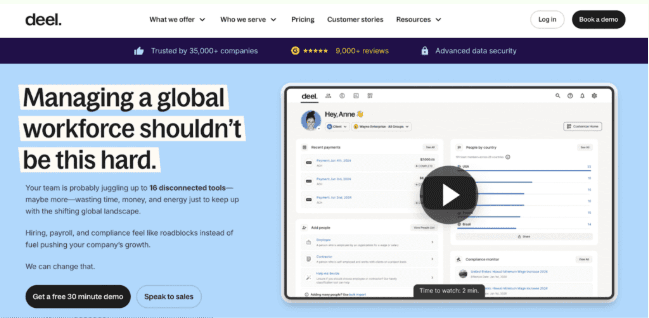
Deel has become one of the most recognized Employer of Record (EOR) platforms in the world. For global companies, its ability to hire across 100+ countries through one dashboard is a strong draw.
But when the focus is India, founders often start looking for Deel alternatives. Deel’s pricing — $599 per employee per month — can feel prohibitive for early teams, especially when costs add up fast.
Support is routed primarily through a ticketing system, which can be slow for time-sensitive issues like reimbursements, payroll corrections, or onboarding blockers.
And because the platform is designed for global scale, the India-specific nuances that matter for startups — from how payroll is structured to how quickly new hires are onboarded — don’t always get addressed.
For startups hiring in India, these trade-offs matter. The EOR you choose sets the pace for onboarding and shapes how much operational work your team still carries. That makes it worth looking closely at what Deel actually provides, and how it compares with other options.
Deel at a glance
The platform’s core promise is centralization: employment contracts, payroll, tax filings, and compliance are all managed through a single interface. Contractors can also be paid and managed alongside employees, which is one reason Deel has become widely adopted.
Who it’s for
Startups and companies needing a mature EOR provider with global reach, who treat India as one of several hiring jurisdictions and want compliance, payroll, and contractor-employee workflows handled centrally.
Key Features
Deel’s India EOR handles contracts, payroll, and statutory compliance (PF, Professional Tax, TDS) via its own/deel-controlled entity.
Offers contractor management and contractor-to-employee conversion workflows.
Employees can opt into private health plans through Deel’s benefits marketplace, but these are optional add-ons in India and not bundled by default.
Onboarding tools: contract issuance, KYC/document collection, bank details collection, often with automated workflows. Typical onboarding time in India is about 3 days for employees.
India-specific HR built-ins: leave entitlements, termination/notice terms, probation, statutory time off, etc., managed per Indian law.
Optional private health plans may be available as add-ons in India, depending on plan and coverage.
Pros | Cons |
|---|---|
Ability to hire globally under a strong, trusted entity | High per-employee fee; cost adds up quickly for early teams |
Polished contractor-to-employee conversion workflows, useful for scaling teams that start with contractors. | Some teams still need manual review of CTC breakups and offer terms to match internal norms. |
Meets statutory benefit requirements, with optional health and wellness add-ons. | Some perks or localized benefits (e.g. private hospitals, regional insurance networks) are optional, not mandatory |
Onboarding relatively fast (~3 days for India) when everything is ready | Onboarding delays happen when documents, background checks, or bank details are slow |
Good compliance infrastructure and contract/legal risk mitigation | Local ops (workspace, hardware, GST) often fall on the founder; support delays for urgent issues |
6 Deel alternatives for India
Here are six providers worth comparing with Deel when building in India.
TeemGenie
Wisemonk
RemoFirst
Multiplier
Papaya Global
Oyster HR
For a step-by-step view of onboarding through an EOR in India, see: EOR Onboarding Explained: Hiring and Onboarding in India
Who it’s for
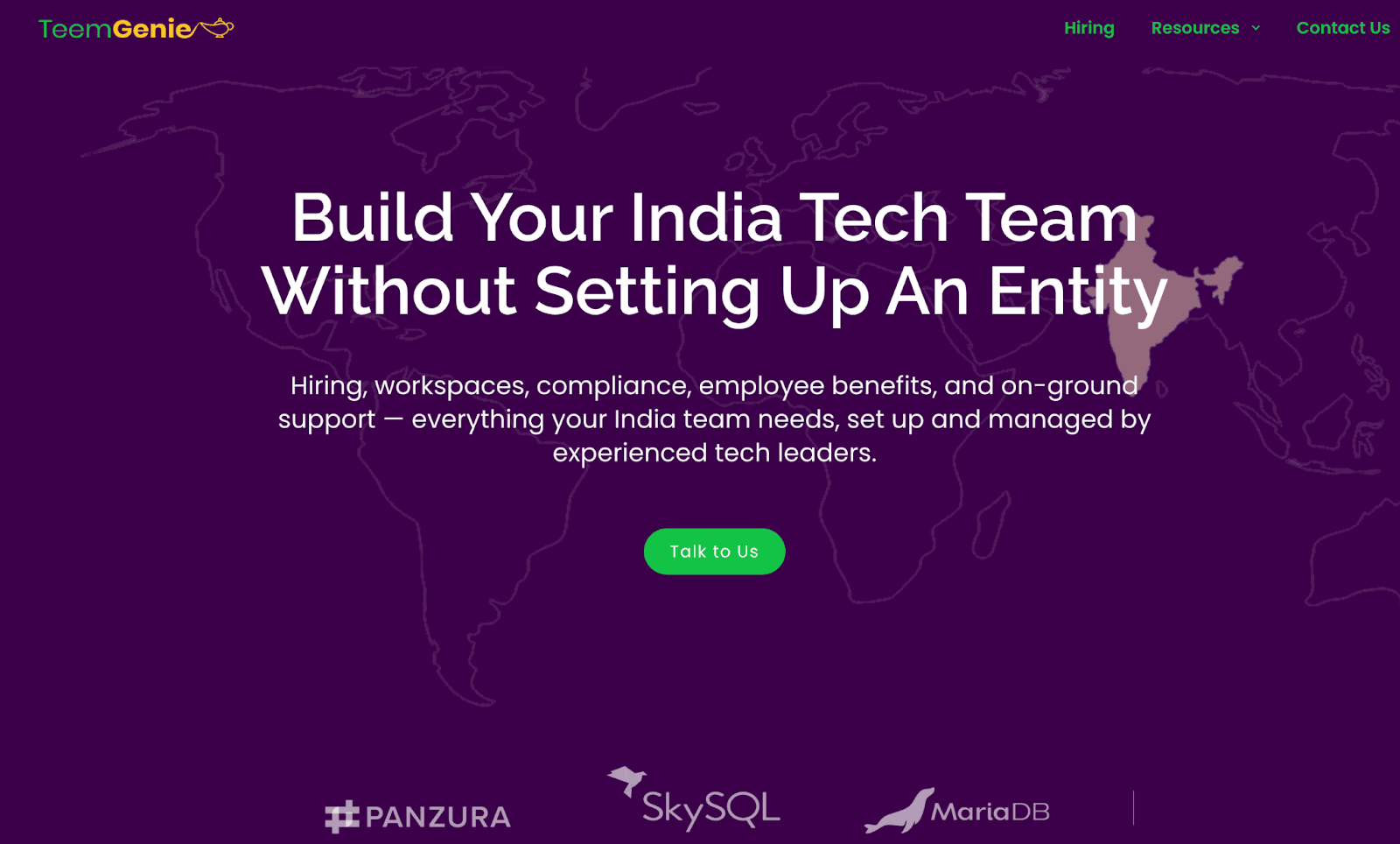
Global founders building tech teams in India who want a people-first EOR partner to manage everything end-to-end – from compliance and payroll to onboarding, equipment, and ongoing dedicated support without setting up a local entity.
Pricing
$399 per employee per month
Sits between budget India-first providers like Wisemonk and global platforms like Deel, with all-in coverage that absorbs costs like GST on equipment and workspace.
Key Features
End-to-end ownership: Goes beyond compliance to cover the “in-between” work (offers, workspace, equipment, engagement) that founders usually get pulled into with global platforms.
India-first design: Built specifically for India’s payroll structures, statutory requirements, and startup context.
Speed: Offers can be issued in under 24 hours, onboarding completed ahead of Day 1.
Operational relief: Removes the need for local vendor management across payroll, background checks, insurance, and IT setup.
Dedicated escalation path: Human-led support in India, not ticket-only, which helps resolve issues quickly.
Workspace & equipment: Laptops/hardware, office seats/home office equipment is procured and delivered locally, (with GST absorbed) through the EOR arrangement.
Employee benefits & engagement:
Statutory benefits covered: Provident Fund (PF), Employee State Insurance, Professional Tax (PT), TDS.
Group health insurance: Standard coverage for medical (₹30 lakh + coverage), term and accidental insurance (3x yearly salary)
Employee engagement: Includes monthly HR-led programs (surveys, activities, wellness), proactive issue escalation, and employer-branding support to help startups retain top talent.
Strengths for Startups
Designed for India-first hiring, tailored payroll structures, statutory compliance, and policies aligned with Indian norms.
Retention-aligned benefits and insurance, uncommon among EORs.
Removes founder bandwidth drain by taking ownership of vendor management, compliance filings, and onboarding logistics.
Human-led, dedicated local support that reduces founder involvement in daily operational firefighting.
Employer branding and engagement programs designed to support retention in early teams.
Limitations
India-only coverage: unlike Deel, Multiplier, or Oyster, TeemGenie does not support multi-country hiring.
Teams scaling beyond 150 employees usually transition to a GCC or hybrid setup.
Pros | Cons |
|---|---|
Covers compliance, payroll, onboarding, workspace, and equipment in one model | Limited to India (not multi-country) |
Dedicated escalation path with local HR support | Scaling to 200+ hires may require a GCC/entity |
Employee engagement programs (HR check-ins, wellness, branding) included | Pricing not as low as India-only budget EORs like Wisemonk |
GST absorbed for laptops/workspace (rare among EORs) | |
Predictable $399/month all-inclusive pricing | |
Who it’s for
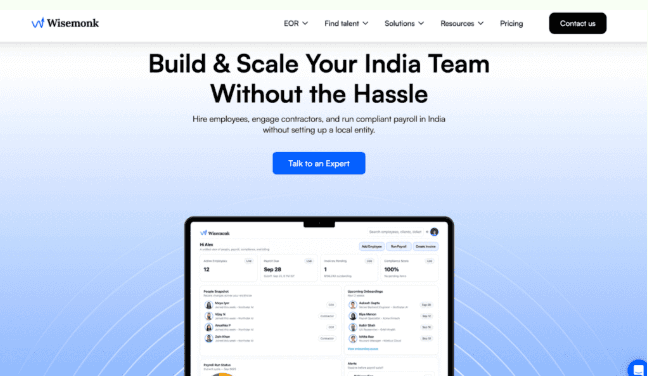
Startups focused on building in India who want a low-cost EOR partner with strong compliance depth, simple onboarding, and transparent pricing. Best suited for early-stage teams who don’t need multi-country coverage yet.
Pricing
From $99 per employee per month for EOR services (one of the lowest published rates among providers in India).
Key Features
Full EOR coverage in India: Contracts, payroll, and statutory compliance (PF, Professional Tax, TDS) handled legally via Wisemonk’s local entity.
Onboarding support: Background checks, documentation, and setup handled locally; designed to reduce friction for first-time India employers.
Benefits administration: Enrollment into statutory and private benefits such as health and wellness insurance.
Transparent pricing: Clear fee structure, no hidden add-ons for basics like payroll filings or compliance.
Equipment support: Equipment support: Can coordinate laptops/workspace if needed (typically scoped separately).
India-only expertise: Deep knowledge of state-wise labor laws and compliance nuances.
Strengths for Startups
At ~99/employee, Wisemonk is the lowest-cost serious EOR option for India.
India-first focus means strong handling of statutory and state-level obligations.
Pricing and inclusions are spelled out in advance, reducing risk of surprise fees.
Designed for early teams that want a quick start without running into paperwork gaps.
Limitations
Support is compliance-first; HR depth and engagement support are lighter than with India-first full-scope EORs.
Procurement is offered but post-delivery support isn’t as standardized as with full-scope providers.
Best for early-stage teams; beyond ~100 hires, founders often graduate to a GCC
Pros & Cons for Startups in India
Pros | Cons |
|---|---|
Extremely low cost ($99/month per employee) | India-only, no multi-country hiring |
Transparent, clear pricing with few hidden fees | HR depth and engagement support less comprehensive than some providers |
Strong compliance expertise at the state level | Equipment support available, but ongoing IT support limited |
Good onboarding experience for early teams | May not scale well for very large teams (100+ employees) |
Who it’s for
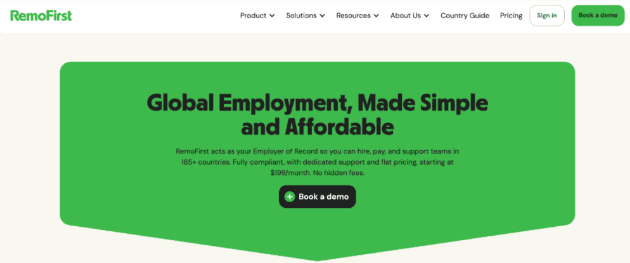
Startups and SMBs that want the most affordable way to hire compliantly in India and other countries. RemoFirst is suited for cost-sensitive teams who want straightforward EOR coverage without paying for premium extras.
No minimum headcount required, which makes it accessible for small teams.
Pricing
~$199 per employee per month for EOR.
Contractor management from $25 per contractor per month.
Key Features
Full EOR coverage in India: Employment contracts, payroll, and statutory compliance (PF, PT, TDS) handled through RemoFirst’s local setup.
Global reach: Coverage in 185+ countries, making it a viable choice if you plan to expand beyond India.
Transparent fees: Flat-rate model with no minimum headcount requirements, which is attractive for small teams.
Contractor management: Dedicated plans for contractors with the option to convert them into full-time employees later.
Equipment & benefits: Hardware and health benefits are offered as add-ons.
Visa and work permit support: For startups hiring globally, RemoFirst includes immigration and relocation assistance.
India payroll structuring: Salaries are processed in compliance with Indian norms (PF, PT, TDS), though founders sometimes note global templates aren’t always adapted to local salary structures.
Onboarding speed: Employees in India can typically be onboarded in 3–7 business days once documentation and background checks are complete.
Customer support: Some plans include a dedicated customer success manager; responsiveness varies by region.
Strengths for Startups
Among the lowest published pricing of global EORs (~$199/employee), especially compared to Deel’s $599.
Flexible for mixed workforces – contractors and employees can both be managed within one platform.
Good fit for startups planning to scale into multiple countries after India.
Transparent and predictable billing reduces the risk of hidden charges.
Support is primarily ticket-based; responsiveness varies by plan and region
Transparent pricing and no minimums means startups can add employees with more flexibility
Limitations
Some countries are covered via local partners rather than RemoFirst-owned entities, which can affect process consistency.
Equipment support exists, but post-delivery services (repairs, replacements, returns) aren’t standardized.
In India, payroll breakups can follow global templates, meaning allowances and reimbursements may not align with CTC norms.
Benefits beyond statutory minimums (like richer health coverage or wellness perks) usually come at extra cost.
Onboarding speed depends on candidate document readiness and background checks; delays are not uncommon.
Pros | Cons |
|---|---|
Very low EOR pricing (~$199/employee/month) | Payroll structures sometimes follow global templates vs India-specific CTC norms |
Transparent, flat-rate billing with no minimums | Benefits beyond statutory minimums cost extra |
Contractor + employee management in one platform | Equipment support and IT services less robust |
Global coverage (185+ countries) | Uses partner entities in some countries, affecting consistency |
24/7 support with option for dedicated manager | Onboarding can take up to a week if docs/back-checks lag |
Who it’s for
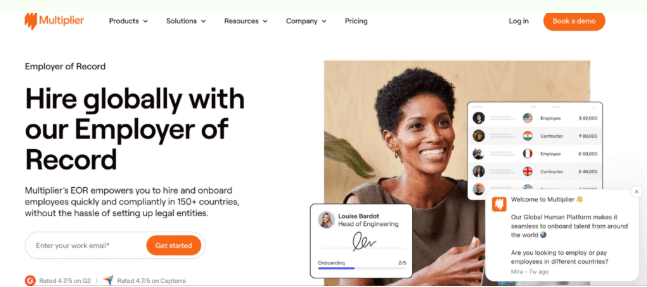
Startups that want to hire in India as part of a broader global plan. Multiplier is best suited for teams that value a tech-forward platform with predictable pricing and need coverage across Asia-Pacific and beyond, not just India.
Pricing
EOR: $400 per employee per month
Contractors: $40 per contractor per month
Transparent, published pricing with no minimum headcount requirements.
Key Features
Global reach: Coverage in 150+ countries for both employees and contractors.
India compliance: Employment contracts, payroll processing, and statutory filings (PF, PT, TDS) handled locally.
Onboarding speed: When documentation is ready, employees can be onboarded in India within a few days.
Transparent fees: Flat, published pricing ($400/employee, $40/contractor) with few additional charges, though some users report occasional billing clarity issues.
Security & compliance: SOC 2 and GDPR compliant, with in-house tax and legal expertise.
Contractor + employee management: Mixed workforce can be run from the same platform.
User experience: Well-rated dashboard and automation tools, praised for ease of use.
Strengths for Startups
Flat fees make it easier to budget compared to premium global EORs like Deel or Papaya.
Strong presence in India and Southeast Asia, helpful for startups scaling regionally.
If India is the first step but expansion to other markets is on the roadmap, Multiplier provides continuity.
Well-rated UX; founders cite ease of use and automation as a key reason to choose Multiplier.
Limitations
Payroll structures and benefits may follow global templates rather than fully tailored India-first models.
Health insurance and perks are considered “standard” by many users; richer wellness packages or stock options are limited or add-ons.
In some countries Multiplier uses local partners rather than its own entity, which can create variation in process and speed.
Billing clarity and support speed for complex cases can be inconsistent.
Pros & Cons for Startups in India
Pros | Cons |
|---|---|
Competitive, flat pricing ($400/employee; $40/contractor) | Salary structures and benefits less localized than India-first providers |
150+ countries supported in one platform | Benefits often described as standard; richer perks cost extra |
Strong presence in APAC, including India | Some users report billing issues or slower support for complex cases |
Modern, automation-driven UX | Relies on local partners in some markets, leading to variable experience |
Who it’s for
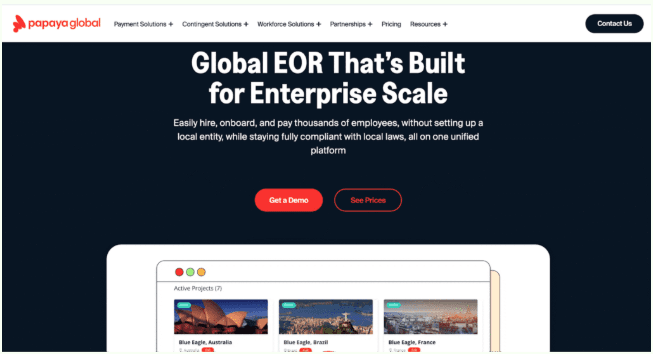
Mid-to-large startups and scaleups that want an enterprise-grade platform to manage global payroll, workforce payments, and EOR. Papaya is a fit if India is just one of several markets you’re hiring in, and automation, analytics, and compliance oversight are as important as onboarding speed.
Pricing
EOR: Typically ranges from $650–800 per employee per month, depending on the country and inclusions.
Contractors: Around $30 per contractor per month.
Software-only Workforce OS: $5–$25 per employee per month.
Papaya typically prices above India-specialist or budget-focused EORs, and leans on automation plus broad country coverage as the trade-off.
Key Features
Global scale: EOR and payroll coverage in 160+ countries, including India.
India EOR scope: Locally compliant employment, payroll processing, and statutory contributions.
AI-assisted payroll: Automated anomaly detection before payroll runs; integrated journal entries and compliance checks.
Workforce payments infrastructure: Licensed payments rails designed for faster, compliant salary transfers across currencies.
Compliance intel: “Countrypedia” resource outlining employer and employee contributions and rules in each country.
Entity model: In many countries, Papaya delivers EOR via local partners; confirm the India model and escalation path during evaluation.
Strengths for Startups
AI validation, embedded payments, and BI dashboards reduce manual admin work and payroll errors.
Strong fit for startups hiring in multiple countries — India included — with one system for payroll and compliance.
Built payments rails reduce failed or late transfers, which can be a pain point with other global providers.
Users highlight easy setup and efficiency improvements in global payroll operations.
Limitations
Pricing is significantly higher than India-specialist providers like TeemGenie or Wisemonk; less suited for seed or Series A teams.
Relies on local partners in many markets, including India, rather than owning entities directly.
India benefits are standardized templates; limited flexibility compared to India-first EORs.
Implementation is often measured in weeks, not days; onboarding speed depends on partner SLAs and candidate documentation.
Pros & Cons for Startups in India
Pros | Cons |
|---|---|
160+ countries supported in one platform | High cost: EOR starts at ~$650 per employee/month |
AI validation, automation, and BI dashboards reduce payroll risk | Relies on local partners (not owned entities) → process variation possible |
Reliable workforce payments with licensed rails | India benefits are standardized; customization limited |
Compliance intel (“Countrypedia”) adds transparency | Onboarding can take weeks depending on partner SLAs and documentation |

Who it’s for
Remote-first startups and global teams that want a consistent EOR experience across 180+ countries, including India, and value an employee-centric platform with compliance automation.
Pricing
From $599 per employee per month for full-service EOR. Pricing can vary by country and headcount; add-ons (benefits, insurance, equity support) may incur extra fees.
Key Features
Global EOR coverage: Hire in 180+ countries with payroll in 140+ currencies. India included, with statutory compliance (PF, PT, TDS).
Fast onboarding: Oyster markets “onboarding in as little as 48 hours” when documentation and KYC are ready.
Compliance automation: Built-in tracking of India’s statutory laws, including time-off, termination, and payroll tax obligations.
Benefits & perks: Offers statutory coverage with optional health insurance and wellness. India-specific private health insurance depends on the plan.
Equity support: Guidance for equity/stock option plans, with tax handling across jurisdictions.
Platform UX: Known for a modern, employee-friendly interface, making it easy to manage contracts, payslips, and leave policies.
Entity model: Mix of owned entities and partners; confirm whether India is served via an owned entity or partner.
Strengths for Startups
Well-suited for remote-first teams hiring across multiple countries, with India as one hub.
Emphasizes global parity in employee benefits and access to programs like Oyster Academy, which can appeal to startups competing for remote talent.
Strong employee experience focus – benefits marketplace, clean UI, self-serve employee portal.
Equity and stock option handling, a differentiator for tech startups competing globally
Credible compliance coverage for Indian payroll and statutory filings.
Limitations
$599+ is on par with Deel, making it heavy for early-stage or budget-conscious startups.
No built-in hardware, workspace, or GST handling for India – founders handle these separately.
Benefits marketplace is global-first; private India health insurance may not align with local startup norms
Support is primarily global-ticket based, with no dedicated local HR team in India.
Operates via partner entity in India, limiting flexibility for founders who prefer direct entity control.
Pros & Cons for Startups in India
Pros | Cons |
|---|---|
Coverage in 180+ countries, payroll in 140+ currencies | High cost ($599+ per employee/month) |
Compliance automation, including India statutory laws | No local execution (hardware, GST, workspace not included) |
Employee-friendly UI and portal | Support for complex payroll can be slower |
Equity support and cross-border stock option handling | India EOR is via partner entity, which may limit flexibility for founders needing direct liability control. |
Optional benefits and learning programs | |
At a glance
Provider | Pricing (per employee/mo) | India-Specific Coverage | Pros | Cons |
|---|---|---|---|---|
TeemGenie | $399 | Full-scope India EOR: payroll + Filings, contracts, onboarding (offers, background checks, bank accounts), workspace & laptops (GST absorbed), Shops & Establishment, gratuity/bonus, local HR & engagement programs. | • End-to-end ownership (compliance, onboarding, equipment, HR) • India-first model • Predictable all-in pricing | • India-only (not multi-country) • Best fit for 5–50 hires; very large (200+) may still need GCC |
Wisemonk | ~$99 | Payroll + PF/PT compliance, contractor handling, optional workspace/equipment coordination, GCC setup advisory. | • Transparent, budget-friendly pricing • India compliance coverage • Covers workspace and equipment setup | • India-only (no global coverage) • Limited HR/employee engagement features • Best fit for early-stage teams • Equipment/workspace support is coordination-only |
RemoFirst | $199 | Payroll + compliance + standard benefits (India included), contractor + employee support, equipment shipping | • Lowest-cost global EOR option • Fast onboarding • Strong contractor management | • Limited India expertise • Less HR support vs local-first providers • Uses partner entities in some countries |
Multiplier | $400 | Payroll + compliance (PF/PT), global coverage (150+ countries), automated onboarding | • Modern UI and workflow automation • Transparent pricing • Good for scaling across multiple countries | • India is one of many markets • Rigid on local policy customizations • Uses local partners in some markets |
Papaya Global | $650–800 | Payroll + compliance (local partners), workforce payments infrastructure for salary transfers | • Enterprise-grade payroll and analytics • Covers 160+ countres • AI compliance monitoring | • Expensive for startups • Operates via partner entity in India • Less personalized, ticket-based support |
Oyster HR | $599 | Payroll + compliance via partner entity, statutory compliance automation, access to global benefits marketplace | • Covers 180+ countries • Stock option/equity handling • Employee branding and programs (e.g. Oyster Academy) | • Partner entity in India • Ticket-based support (no local HR team) • India benefits may not align with local startup norms |
Choosing the Right EOR for Your India Team
The best EOR for India depends on what your startup needs most.
If cost control is the top priority, India-first providers like Wisemonk or RemoFirst can get you compliant at the lowest rates.
If you want depth in local execution—onboarding, equipment, HR engagement, and compliance handled together—TeemGenie is the only provider designed end-to-end for India startups.
If India is just one of many markets, global platforms like Deel, Multiplier, Papaya, or Oyster provide multi-country consistency, though often at higher cost and with lighter local touch.
When comparing, focus on three questions:
Stage – India-only early team vs multi-country expansion
Scope – compliance-only vs onboarding + equipment + HR support
Support – local escalation vs ticket-based support
Answering these makes the right fit clearer.
For a broader provider comparison, see: Best Employer of Record in India: 2026 EOR Comparison
Next Step
If you’re a founder planning to hire in India this year, talk to providers early. Pricing, support, and inclusions vary more than most teams expect — and choosing the wrong model can slow down onboarding or leave gaps you’ll end up managing yourself.
If you’re evaluating Deel alternatives for India, ask each provider whether they own the India entity, what’s included in onboarding, and how escalations work locally.
👉 Schedule a call with TeemGenie to see how a full-scope India EOR compares with global platforms.